Excavation & Grading in Washington Township / Sewell, NJ
Washington Township (Sewell), Gloucester County. Family-owned, licensed and insured, and self-performing every stage of the work since 1979.
We excavate and grade properties throughout Washington Township in Gloucester County. Most jobs here involve development-era homes: taking out pools, decks and patios added in the 1990s, regrading lots where clay layers keep water sitting on the surface, digging footings for additions and trenching for utilities. Every dig is backfilled in compacted lifts and graded to drain.
Free written estimates. Licensed and insured. Every site is quoted individually.
Free estimate in Washington Township / Sewell, NJ
Development lots reaching their second life
Washington Township filled in quickly through the 1970s, 80s and 90s, and the result is street after street of similar colonials and bi-levels on quarter- to half-acre lots. Those homes are solid — poured foundations, plastic laterals — but the yards around them are now thirty to fifty years old. Owners are removing the backyard features previous owners installed and reshaping the lot for how they actually use it.
That makes our work here mostly about the ground surrounding the house: taking things out, filling properly, and leaving a surface that drains.
Removing the 1990s backyard
A large share of township properties added an in-ground pool, a raised deck on concrete piers, or a patio during the 1990s. Many of those are now failing or simply unwanted. Removal is an excavation job before it's anything else: breaking out concrete, pulling piers and footings, removing buried plumbing and electrical runs, and hauling away debris rather than burying it on site.
What happens next matters more than the demolition. A hole left by a pool or a row of pier footings has to be filled with suitable material in compacted layers. Otherwise, the lawn sinks for years afterward and creates a new low spot that holds water.
Sandy loam on top, clay below
Ground across much of the township is sandy loam sitting over clay. The sand on top digs easily and drains well, so it can look like a lot should handle rain without trouble. The clay layer underneath is what stops the water. Once the sand above it saturates, water has nowhere to go but sideways or up, and lawns stay soggy for days after a storm.
When we excavate, we note where that clay sits, because it decides whether a drainage fix should move water across the surface or try to get it down into the ground. On many lots, moving it across the surface toward a legal outlet is the only option that works.
Cut-and-fill subgrade
Developers built many neighborhoods by shaving high ground and pushing it into low ground, then running heavy equipment over the lot. The compacted subgrade under the topsoil can be almost as tight as the natural clay. We often find a thin layer of topsoil over dense, machine-packed fill that sheds water instead of absorbing it.
For grading, that means loosening or replacing the surface layer as well as shaping it. For structural work, it means digging through the fill to find native bearing soil.
Regrading to an outlet
One development handles a heavy rain fine while the next holds water for days, depending on how the lots were graded and where the clay lies. Our regrading starts with elevations: where water enters, where it collects, and where the lowest legal discharge point is. We then cut and fill to create a continuous fall away from the foundation and toward that outlet — never onto a neighbor's yard.
Lower ground near the creeks
Toward the Grenloch and Mantua Creek drainages, the land drops and the ground gets wetter. Excavations there are more likely to hit water, and the soil can turn soft after a wet stretch. We schedule deeper work for drier periods when we can, and bring pumps when we can't.
What we excavate for
Typical Washington Township projects include:
- Pool, deck-pier and patio removal with compacted backfill
- Footings for additions, sunrooms and detached garages
- Lot regrading and swale cutting
- Base excavation for replacement driveways and walks
- Trenching for sewer laterals, water services and drain lines
Footings for additions
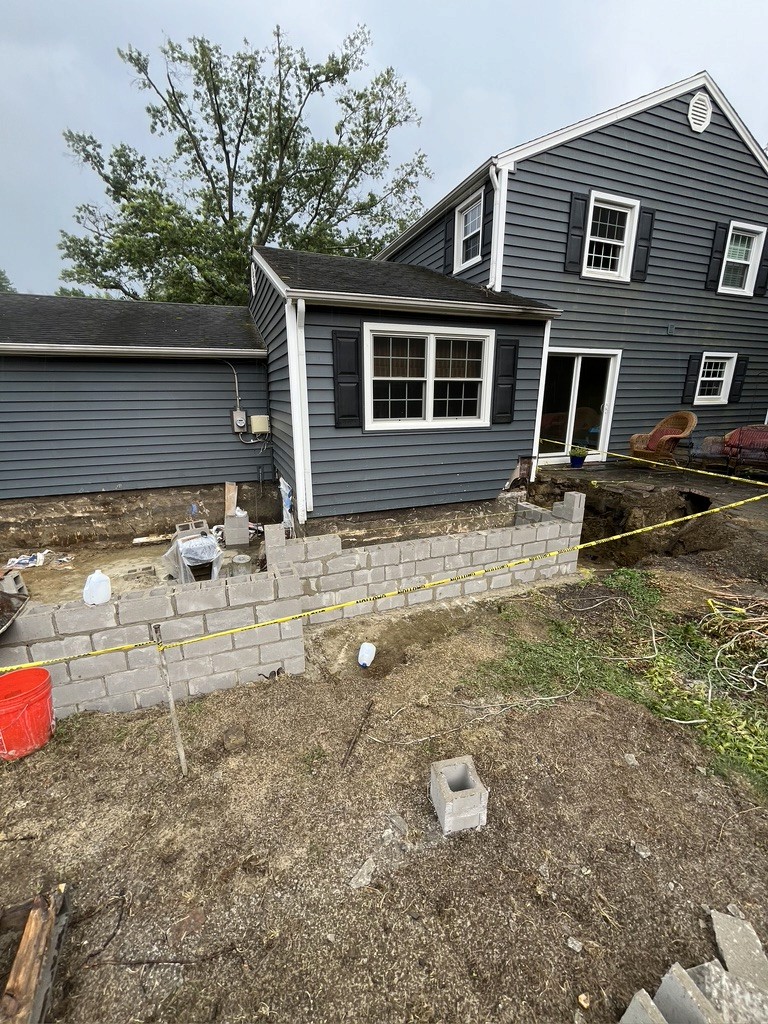
Plenty of township owners expand rather than move. We excavate addition footings below the frost line to undisturbed soil, remove any loose fill in the footprint, and have the excavation inspected before concrete is placed. Around the finished foundation, backfill goes back in lifts and is pitched away from the wall.
Driveway and walk replacement
Driveways poured when these developments were built are at replacement age. A new slab lasts only as long as what's under it, so we excavate below topsoil and soft material and install a compacted stone base before any forms are set.
Utility trenching with the WTMUA
Washington Township Municipal Utilities Authority handles both water and sewer here, with wastewater treated by the Gloucester County Utilities Authority. When we trench for a lateral or water service, we coordinate the connection with the WTMUA, set pipe to a consistent grade on a proper bedding, and backfill so the trench line doesn't sink.
Sandy trench walls
Sand digs fast, but it doesn't stand on its own once a trench gets deep. In the sandier sections we slope, bench or shore trench walls for the actual depth and soil, and keep spoil piles back from the edge. Wet-season work adds pumps so pipe goes into a firm bottom.
Commercial corridors
Along Route 42 and Egg Harbor Road, we take on smaller commercial excavation — utility connections, pad prep and site grading — staged around business hours and parking access.
Locating before we dig
Every job begins with a utility markout. Development lots usually have gas, electric, cable and irrigation lines running through the same strips we need to dig, and we hand-expose marked lines near the work rather than trusting a machine to find them.
Permits and inspections
Footings and structural excavation are inspected before concrete, and work within the street right-of-way needs township approval. We take care of the paperwork and scheduling as part of the job.
Leaving the yard usable
When the digging is done, we fine-grade, spread topsoil and leave the area ready for seed or sod, with the final grade pitched to drain. Equipment routes across the lawn are repaired, not left as ruts.
Emergency sewer excavation
If a sewer line fails and backs up, our crews respond around the clock.
Sewage backing up right now? Call (856) 488-2227 — 24/7 emergency service.
Emergency sewer repair in Washington Township / Sewell ↗Recent projects near Washington Township / Sewell.
Washington Township / Sewell questions, answered.
Yes. We dig out the piers and footings rather than cutting them at grade, then backfill and compact the holes.
Usually a clay layer or compacted fill sits below the sand and stops water from soaking in. Regrading to move water across the surface is often the fix.
Yes. We coordinate connections and inspections with the authority as part of the work.
We take on smaller commercial jobs such as utility connections and pad prep, scheduled around business access.
Other services in Washington Township / Sewell.
- Concrete Driveways & Patios in Washington Township / Sewell, NJ ↗
- Demolition in Washington Township / Sewell, NJ ↗
- Drainage & French Drains in Washington Township / Sewell, NJ ↗
- Lead Service Line Replacement in Washington Township / Sewell, NJ ↗
- Inground Pool Removal in Washington Township / Sewell, NJ ↗
- Sewer & Water Line Repair in Washington Township / Sewell, NJ ↗
- Everything we do in Washington Township / Sewell, NJ ↗
Excavation & Grading — Washington Township / Sewell, NJ