Drainage & French Drains in Washington Township / Sewell, NJ
Washington Township (Sewell), Gloucester County. Family-owned, licensed and insured, and self-performing every stage of the work since 1979.
We fix soggy yards, standing water and basement seepage across Washington Township and Sewell in Gloucester County. Sandy loam over clay drains unevenly here, and compacted subgrade in many developments makes it worse. We find where the water comes from, install French drains, regrading and downspout lines, and carry it to a legal outlet.
Free written estimates. Licensed and insured. Every site is quoted individually.
Free estimate in Washington Township / Sewell, NJ
One development drains, the next one floods
Homeowners in Washington Township often notice that their street holds water for days while a development half a mile away dries out by morning. That's the ground. Gloucester County soil here is sandy loam over clay in many places, and the clay layers decide where water can soak in and where it stops.
Flat to gently rolling land doesn't help. Without much slope, water that can't soak in has nowhere to run, and it collects in the lowest corner of the lot — usually beside a patio, in the back yard, or against the foundation.
Compacted lawns over cut-and-fill
Much of the township was built in the 1970s, 80s and 90s as development construction on quarter- to half-acre lots. Where builders used cut-and-fill, heavy equipment compacted the subgrade under what later became lawn. A few inches of topsoil went on top. Rain soaks those few inches and then hits a layer almost as tight as pavement.
That's why a Washington Township yard can feel spongy after a storm even when it looks flat and healthy. The fix is giving that perched water a path out, not adding more topsoil.
Lower, wetter ground near the creeks
Toward the Grenloch and Mantua Creek drainages, the land drops and gets wetter. Properties there collect runoff from higher ground around them, and the soil stays saturated longer into spring. Drainage design on those lots has to account for water arriving from outside the property line, not just what falls on it.
How we diagnose
We look at the yard in its real condition, ideally after rain, and trace water from source to low point:
- Downspouts discharging at the foundation or into a crushed buried line
- Runoff entering from a neighboring lot or the street
- Perched water sitting on clay or compacted subgrade
- Low spots left where a pool, deck or patio was removed
- Driveways or patios pitched toward the house
French drains that reach the problem layer
Our French drains are trenches lined with filter fabric, filled with clean stone and carrying perforated pipe at a continuous fall. On compacted ground, the trench has to cut through the tight layer so water can drop into the stone. In the sandier sections, fabric keeps fine sand from clogging the drain.
We set grade with a laser along the full run so the pipe never holds water in a low spot of its own.
Removed pools and decks leave low spots
Many properties here added pools, decks and patios in the 1990s that are now being taken out. When a pool removal is backfilled without proper compaction, or a deck comes down and leaves a bare depression, the yard gains a new low point. We regrade those areas with compacted fill so they shed water instead of collecting it.
Roof water and regrading
Downspouts that empty beside the foundation send a roof's worth of water into the soil against your basement wall. Carrying them away in buried solid pipe and regrading so the ground falls from the house for the first several feet often solves the problem on its own. New fill is compacted in lifts so the grade holds.
A legal outlet for every drain
Clay doesn't absorb much, so dry wells only work in the sandier parts of the township. Elsewhere, water has to reach daylight at a lower point or another outlet the township allows. We design the outlet first, then build back from it, and we never route water onto a neighbor's property.
Basement water
Ground water seeping in after storms is usually best fixed outside: roof water, grading and interception. If the basement is taking sewage, that's a sewer problem and needs fast attention.
Sewage backing up right now? Call (856) 488-2227 — 24/7 emergency service.
Emergency sewer repair in Washington Township / Sewell ↗Driveways at replacement age
Driveways and walks poured with the original developments are now at replacement age, and many pitch water toward the garage. When a drainage run crosses one, we self-perform the concrete restoration — or rebuild it on a proper stone base with the pitch corrected.
Maintenance after the job
A well-built drain needs very little care, but it isn't zero. We install cleanouts on longer runs so the pipe can be flushed if sediment ever builds up, and we show you where the outlet is so you can keep leaves and mulch from covering it. Gutters matter too: if they overflow, roof water bypasses the downspout lines entirely. A quick check after the first few heavy storms tells you the system is doing its job.
Utilities and wet-season digging
The Washington Township MUA provides water and sewer. We have utilities marked and locate private lines before trenching. Wet-season work often needs a pump, and sandy sections need trench support; we plan for both so pipe is bedded in a firm, dry trench.
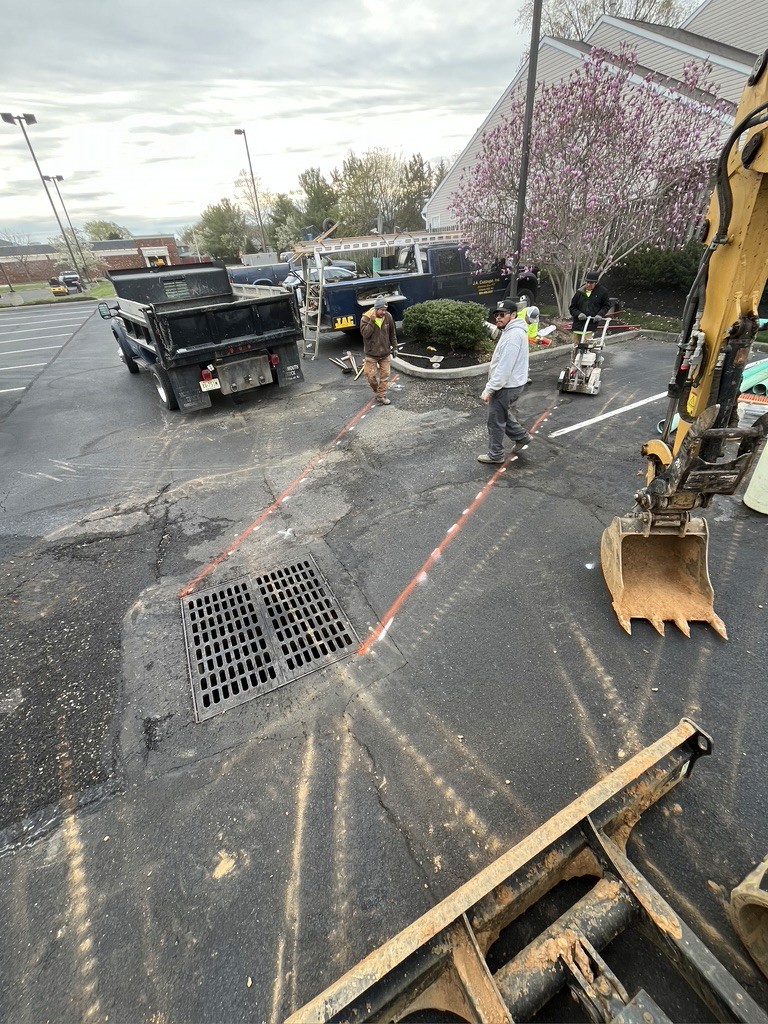
Recent projects near Washington Township / Sewell.
Washington Township / Sewell questions, answered.
Clay layers and compacted subgrade vary from lot to lot. Where water can't soak through, it perches below the topsoil until a drain gives it a path out.
Yes. We regrade the area with compacted fill so it sheds water, and add a drain if the surrounding ground needs one.
In sandier sections, sometimes. Over clay, they fill and stay full. We check the soil before recommending one.
Usually not. The problem is the tight layer underneath. Drainage that cuts through it works; more topsoil just holds more water.
Other services in Washington Township / Sewell.
- Concrete Driveways & Patios in Washington Township / Sewell, NJ ↗
- Demolition in Washington Township / Sewell, NJ ↗
- Excavation & Grading in Washington Township / Sewell, NJ ↗
- Lead Service Line Replacement in Washington Township / Sewell, NJ ↗
- Inground Pool Removal in Washington Township / Sewell, NJ ↗
- Sewer & Water Line Repair in Washington Township / Sewell, NJ ↗
- Everything we do in Washington Township / Sewell, NJ ↗
Drainage & French Drains — Washington Township / Sewell, NJ