Home/Services / Septic to Sewer Conversion
Septic to Sewer Conversion in South Jersey
Permits, fees, the sewer lateral, and abandoning your old tank, all handled by one crew.
What a conversion includes.
Switching from septic to public sewer is more than tying a pipe into the street. It is a sequence of approvals, digging, and cleanup, and every piece has to be done in order. When we take on a conversion, the job covers:
- Municipal approval from your town
- The county sewer connection permit
- Excavating and installing the sewer lateral from your house to the street connection
- Abandoning the septic tank: pump-out, then crush and fill or remove it, per local code
- Required inspections
- Yard, walkway, and driveway restoration
One crew does the digging, the pipe, the tank, and the restoration. You are not juggling an excavator, a plumber, a septic hauler, and a landscaper, and nobody can point at someone else when a step is late.
Before we write an estimate, we walk the property with you. We look at where the house drain leaves the foundation, where the street connection is, where the tank sits, and what is in between: driveways, walkways, trees, fences, gas and electric lines. That walk is what lets us give you a written number instead of a guess.
We also call in utility markouts before any digging, so buried gas, electric, water, and communication lines are located and avoided. It is a required step and an easy one to overlook if you are coordinating the work yourself.
The full cost breakdown.
The only fixed number is the county fee. Everything else depends on your property, so we quote it after we see it.
| Item | Cost | Notes |
|---|---|---|
| CCMUA connection fee (Camden County) | $6,618 per EDU | As of April 21, 2026. A single-family home is one EDU. CCMUA resets the fee annually each spring. |
| Municipal connection fee | Varies by town | Charged separately from, and in addition to, the CCMUA fee. |
| Sewer lateral installation | Quoted on site | Depends on distance to the street connection, depth, and what is in the way. |
| Septic tank abandonment | Quoted on site | Depends on tank size, access, and the method local code requires. |
| Restoration | Quoted on site | Depends on whether we cross lawn, walkway, driveway, or landscaping. |
The CCMUA fee is set by the Camden County Municipal Utilities Authority, not by us, and it changes every spring. For how it is calculated and what counts as an EDU, see our CCMUA sewer connection fee guide.
Paying the county fee in installments.
A connection fee of $6,618 is a lot to pay at once, especially when the conversion was not your idea. CCMUA offers an installment plan for properties converting from septic or cesspool to public sewer.
You apply for the installment plan when you submit your connection application, so decide before the paperwork goes in. If you are not sure whether you qualify, ask CCMUA directly, or ask us and we will point you to the right contact. Current terms are on CCMUA's Connecting to the Sewer page.
The installment plan covers the county fee only. Your town's fee and the construction work are separate.
When you plan your budget, think of the conversion as three separate payments that land at different times: the county fee (paid in full or on the installment plan), your town's fee, and the construction contract. Knowing that up front makes it easier to decide whether the installment plan is worth applying for.
Permits, in the right order.
- 01
Municipal approval
Your town signs off on the connection first. This is usually where the municipal connection fee and any local paperwork come in.
- 02
Sewer extension approvals, if the main is new
If the sewer main on your street is newly built, any required extension approvals have to be in place before individual homes can connect to it.
- 03
CCMUA Sewer Connection Permit
In Camden County, a CCMUA Sewer Connection Permit is required before any physical connection is made. No permit, no digging into the system.
- 04
Fee payment
The CCMUA connection fee and municipal fee are paid, or an installment plan is set up, as part of the permit process.
- 05
Excavation and connection
We dig, lay the new sewer lateral from your house to the street connection, and tie it in.
- 06
Inspection
The connection is inspected before it is buried, so it is approved while everything is still visible.
- 07
Septic abandonment and restoration
We abandon the old tank to local code, backfill, and restore the yard, walkway, or driveway.
We pull the permits and coordinate every step.
What to expect on site.
Once permits are approved and fees are handled, the construction itself moves quickly. Here is what a typical conversion looks like from your side of the fence.
Before day one, we confirm the schedule with you and with the town inspector, and utility markouts are completed. You will see paint and flags in the yard showing where buried lines run. We tell you where equipment will park and which areas of the yard we will be working in, so you can move cars, planters, or outdoor furniture ahead of time.
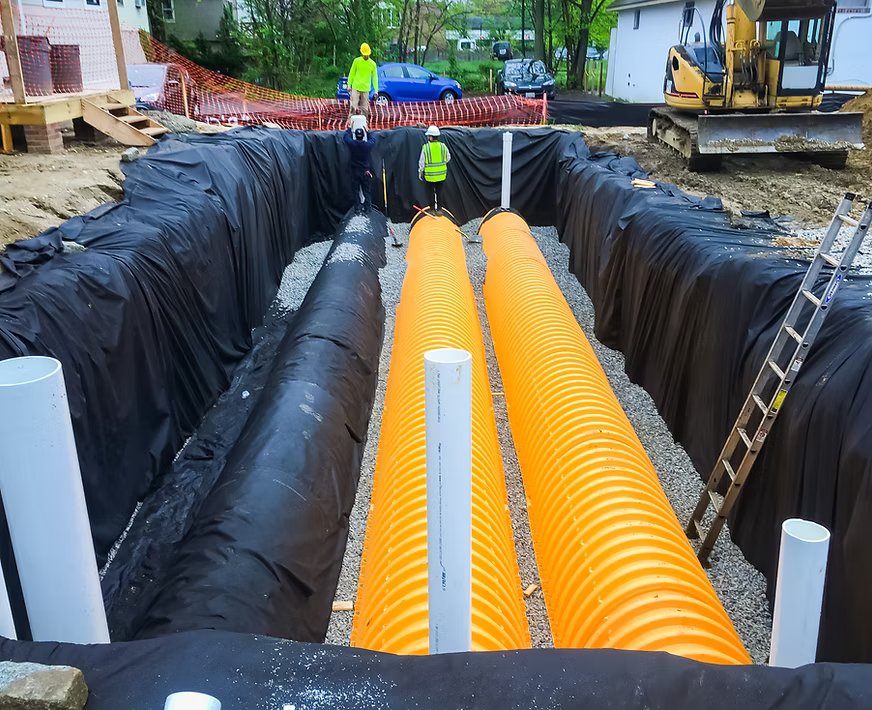
On the first day, we excavate along the lateral route and at the street connection. Where the line crosses a walkway or driveway, we cut it cleanly so the patch is neat. The new pipe is laid at the correct slope so it drains on its own, bedded properly, and connected at both ends.
The house is switched over from the septic tank to the new lateral, usually with only a short window when you should avoid running water. The inspector checks the connection while it is still exposed. After approval, we abandon the tank, backfill, and compact everything in layers so the ground does not settle into a dip later.
The last step is restoration: topsoil and seed or sod on lawns, and patching for walkways and driveways, as spelled out in your estimate. We clean up the site each day, and we leave you with copies of the permits and inspection approvals for your records.
The lateral itself is the biggest variable in the construction price. A house set close to the street with a clear front yard is a very different job from a long run under a driveway or around mature trees. Depth matters too: if the street connection is deep, the trench has to be deeper and wider to be dug safely. That is why we will not quote it over the phone.
Do I have to connect, and how fast?
Once public sewer is available to your property, many towns require you to connect within a set period. That deadline is set by local ordinance, and it varies from town to town.
Your town's sewer notice should say what the rule is and when the clock starts. If the notice is unclear, or you have misplaced it, call us. We work in these towns regularly and can help you find out what applies to your street, and how much time you realistically have to line up permits, fees, and a crew.
Our advice is not to wait until the last few weeks. Permits take time, and when a whole street gets the same notice, contractors' calendars fill up at the same moment.
Some homeowners also choose to connect early, before any deadline, because their septic system is aging, needs a costly repair, or is simply something they would rather stop worrying about. If sewer is already available on your street, there is usually no reason you have to wait.
Neighborhood-wide conversions.
Sometimes a town converts a large section of homes from septic at once. In that situation, CCMUA's rules allow the connection fee to be waived. Runnemede's 2025 agreement covering a 97-home area is one example.
If your street is part of a town project, ask your municipality whether a waiver applies before you pay anything. And talk to us about scheduling neighbors together. When several homes on the same block convert in sequence, the work is easier to plan and the street is torn up for less time overall.
Outside Camden County?
The CCMUA fee only applies in Camden County. Towns in Burlington and Gloucester Counties are served by different sewer authorities, each with its own fees, permits, and rules.
We do conversions there too. Tell us your address and we will walk you through the local requirements before you commit to anything.
The physical work is the same wherever you live: approvals, a lateral from the house to the street, abandoning the tank, and restoring the yard. What changes from one authority to the next is the paperwork, the fee schedule, and the inspection process. We will tell you which authority serves your address and what they require, and we will not guess at fees we have not confirmed.
Septic tank abandonment.
Once your house drains to the sewer, the septic tank is no longer needed, but it cannot just be left in the ground. It has to be abandoned properly, and local code sets how.
A septic tank is a large buried concrete, steel, or fiberglass box that has been holding wastewater for years. Steel tanks in particular rust from the top down, and concrete lids crack. Once the tank is no longer in use and is not maintained, those weaknesses only get worse.
The usual process:
- Pump the tank out completely
- Disconnect it from the house line
- Crush or break the tank in place and fill it, or remove it entirely, depending on what local code requires
- Backfill, compact, and restore the surface
- Have it inspected where required
We also look for the drain field and any distribution box during the site visit. Local code determines what, if anything, has to be done with them, and we include that in the estimate so there are no surprises.
Doing it right matters for three reasons. Safety: an empty or poorly abandoned tank can collapse under a person, a mower, or a vehicle, and old tank lids are a known hazard. Code: towns require abandonment as part of the conversion, and skipping it can hold up final approval. Selling: buyers and inspectors ask about septic systems, and documentation that the tank was properly abandoned keeps that question from turning into a problem at closing.
Estimate your government fees.
Camden County properties. Enter your EDUs and your town's connection fee to total what you will owe in fees before any construction.
An EDU, or equivalent dwelling unit, is how sewer authorities measure expected flow. A single-family home is one EDU. Duplexes, multi-family buildings, and commercial properties may count as more than one, so check with CCMUA if your property is not a single home.
- CCMUA fee (1 × $6,618)
- $6,618
- Municipal connection fee
- $0
- Estimated government fees
- $6,618
Excavation, lateral installation, tank abandonment and restoration are quoted after a free site visit. CCMUA rate effective April 21, 2026.
- Family-Owned Since 1979
- Licensed & Insured
- NJLICA Member
- Free Written Estimates
- 24/7 Emergency Response
Related services.
Towns we serve.
- Cherry Hill, NJ
- Voorhees, NJ
- Marlton, NJ
- Haddonfield, NJ
- Moorestown, NJ
- Mount Laurel, NJ
- Medford, NJ
- Collingswood, NJ
- Camden, NJ
- Gloucester Township, NJ
- Washington Township, NJ
- Sicklerville, NJ
- Berlin, NJ
- Maple Shade, NJ
- All Service Areas ↗
Common questions, honest answers.
Often, yes. Once public sewer is available to your property, many towns require you to connect within a set period. The deadline is set by local ordinance and varies by town, so check the notice your town sent or ask us and we will help you find the rule that applies to your street.
The cost has two parts. Government fees: the CCMUA connection fee is $6,618 per EDU as of April 21, 2026 (a single-family home is one EDU), plus your town's municipal connection fee, which varies by town. Construction: the sewer lateral, septic tank abandonment, and restoration, which depend on your property and are quoted after a free site visit. Use the estimator on this page to total the government fees.
CCMUA offers an installment plan for properties converting from septic or cesspool to public sewer. You apply for it when you submit the connection application. See CCMUA's connection page for current terms.
It has to be properly abandoned. That means pumping it out, then crushing it in place and filling it, or removing it entirely, depending on local code. A tank left in the ground without being abandoned properly can collapse and become a serious safety hazard.
The work at your property usually takes a few days once permits are approved and fees are paid. The permit process before that often takes longer than the construction. We give you a realistic schedule in your written estimate.
There will be digging, both for the lateral and at the tank. We keep the trench as narrow as practical, separate topsoil, and restore the lawn, walkway, or driveway as part of the same job and the same estimate.
We cannot speak to property values, so talk to a real estate professional about that. What we can say is that buyers and inspectors ask about septic systems, and a completed, inspected sewer connection with a properly abandoned tank and paperwork to show for it answers those questions cleanly.
Free Written Estimate
Got a sewer connection notice? Send it to us.
Send us your town's notice with your request. We will explain what it requires and give you a free written estimate for the whole conversion.