Inground Pool Removal in Washington Township / Sewell, NJ
Washington Township (Sewell), Gloucester County. Family-owned, licensed and insured, and self-performing every stage of the work since 1979.
{{ NEEDS REAL DATA: typical price band for inground pool removal in Washington Township }} is the band for inground pool removal in Washington Township (Sewell), NJ. The township has one of the densest concentrations of 1970s–90s back-yard pools in Gloucester County. J.A. Cuzzupe Inc. demolishes, hauls, backfills in compacted lifts and regrades — family-owned since 1979.
Free written estimates. Licensed and insured. Every site is quoted individually.
Free estimate in Washington Township / Sewell, NJ
Why this comes up in Washington Township / Sewell.
Washington Township grew almost entirely as tract housing between the mid-1970s and the late 1990s, and a remarkable share of those homes went in with a pool — Birches, Whitman Square, Hurffville and the developments off Egg Harbor and Greentree Road. Two things follow from that. First, the pools are all reaching end of life at roughly the same time, which is why there is a steady queue of removals here rather than an occasional one. Second, the original owners are now selling or downsizing, and a forty-year-old vinyl-liner pool with a failing wall and an obsolete heater is a line item buyers use to negotiate. So the typical trigger is either a liner and plumbing failure that costs more to fix than the pool is worth, or a pre-sale decision to hand the buyer a flat, usable back yard instead of a maintenance obligation. Lots are generously sized and mostly flat with sandy soil, which makes access easier here than in the older Camden County boroughs.
Housing stock
Washington Township grew heavily through the 1970s, 80s and 90s, and the housing is mostly single-family development construction on quarter- to half-acre lots, with a large stock of similar-vintage colonials and bi-levels. Poured foundations and plastic laterals are the norm, so the recurring problems are drainage, settlement and aging flatwork rather than collapsed clay pipe. Driveways and front walks poured with the original developments are now at replacement age, and a great many properties added decks, pools and patios in the 1990s that are now being removed or replaced. Commercial work concentrates along the Route 42 and Egg Harbor Road corridors.
Ground conditions
Gloucester County ground here is sandy loam over clay in many places, flat to gently rolling, and it drains unevenly — one development handles a storm and the next one over holds water for days. The clay layers are what stop infiltration, and where developments were built on cut-and-fill the compacted subgrade under lawns makes it worse. Toward the Grenloch and Mantua Creek drainages the ground gets lower and wetter. Depth to water is generally workable for utility trenching, though wet-season work needs pumps and sandy sections need trench support.
How the job runs in Washington Township / Sewell.
- 01
Site visit to confirm pool construction — a large share of township pools are steel-wall vinyl rather than gunite, which changes the demolition method.
- 02
File the Washington Township demolition permit and arrange electrical and gas disconnects.
- 03
Drain the pool to an approved discharge point.
- 04
Remove the liner, equipment pad, filter, heater and plumbing runs.
- 05
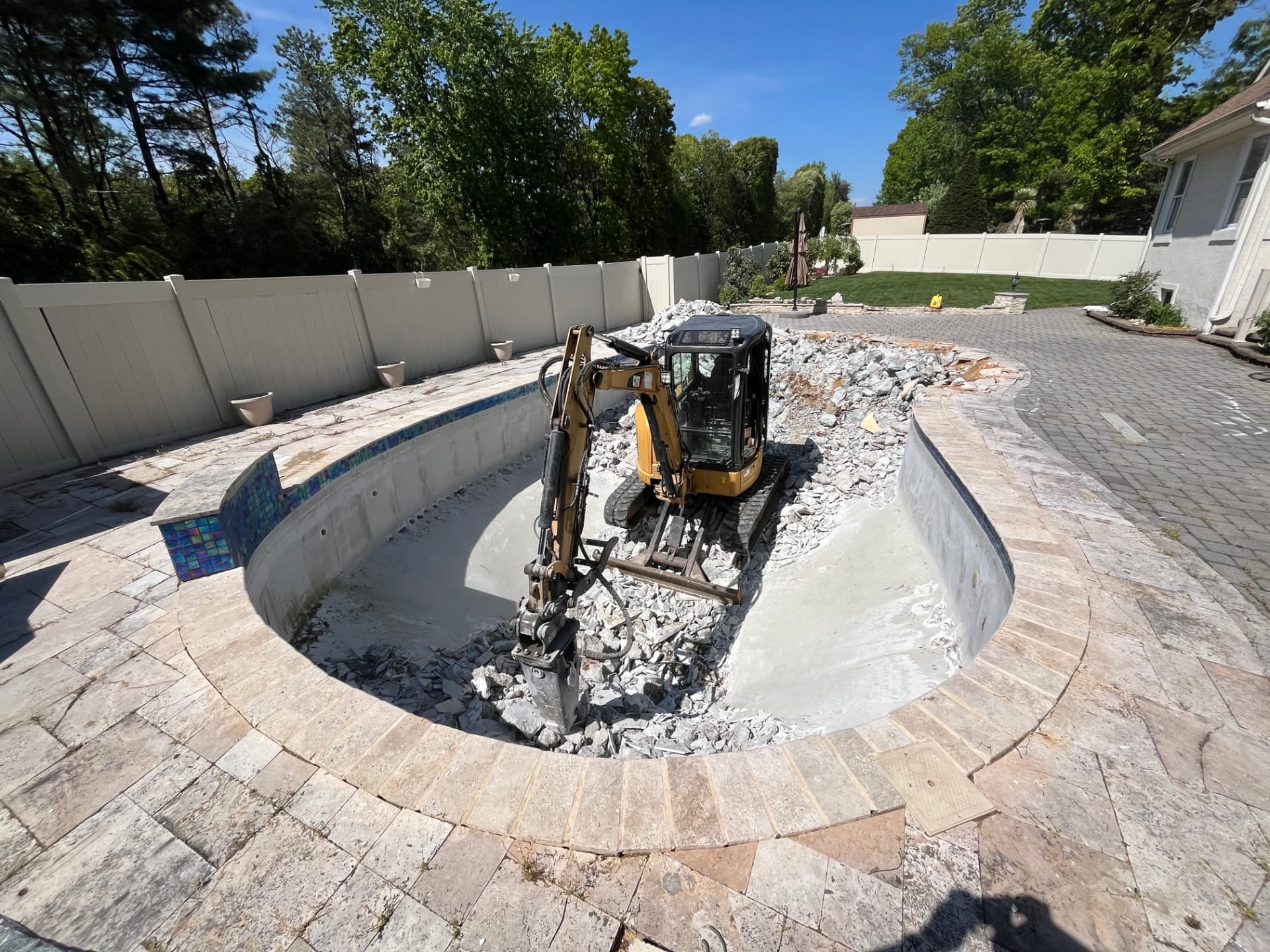
Demolish the walls and floor — full removal, or break-down and perforate for a partial fill-in.
- 06
Haul the debris off and backfill with clean structural fill in compacted lifts.
- 07
Final grade with positive fall away from the house, then topsoil and seed.
What inground pool removal costs in Washington Township / Sewell.
{{ NEEDS REAL DATA: typical price band for inground pool removal in Washington Township }}
That is a typical range, not a quote. Every site is different and every job is priced individually after we have walked it — in writing, with the scope itemized.
What moves the number in Washington Township / Sewell
| Factor | Effect on price |
|---|---|
| Steel-wall vinyl vs. gunite construction | Vinyl-liner pools with steel or polymer walls come out faster and lighter than a gunite shell, and that shows up in the price. |
| Pool depth | A diving well means more excavation, more haul-out and considerably more imported fill than a uniform-depth pool. |
| Concrete decking area | Township-era pools often carry a large concrete surround. Removing all of it is separate tonnage from the pool itself. |
| Access from the street | Most lots here have workable side-yard access, which keeps costs down — but corner lots, sheds and irrigation in the path still add work. |
| Fill quantity and haul distance | Clean structural fill is priced per load, and volume tracks pool depth more than footprint. |
| Timing against a sale | Compressed schedules around a closing date limit flexibility on trucking and disposal and can affect pricing. |
Permits in Washington Township (Sewell).
We file the permits and schedule the inspections ourselves — it isn’t left on your plate.
Washington Township requires a demolition permit for inground pool removal with an electrical closeout on the pool's dedicated circuit. Where the pool barrier fence is being removed with the pool, that comes off the property's pool-barrier obligation as part of the same closeout. {{ NEEDS REAL DATA: Washington Township permit fee and application requirements for inground pool demolition and backfill }}
- Office
- Washington Township Department of Code Enforcement and Inspections
- Address
- 523 Egg Harbor Road, Sewell, NJ 08080
- Hours
- Monday–Friday 8:00am–5:00pm; closed Fridays Memorial Day through Labor Day
Recent projects near Washington Township / Sewell.
Washington Township / Sewell questions, answered.
It depends on the pool's condition. A functioning pool is an amenity to some buyers. A forty-year-old pool with a failing liner and a dead heater is a negotiating point that tends to cost more in price reduction and inspection credits than the removal would. If yours is closed and has been for a season or two, removing it usually presents better than explaining it.
Generally yes. There is less material to break and far less tonnage to haul than a gunite shell of the same size. The backfill requirement is the same though — the cavity still has to be filled in compacted lifts, and that part doesn't get cheaper because the walls were thinner.
It's your call, but leaving it is usually a false economy. The deck edge ends up sitting proud of the settled fill, it cracks along the old pool line, and removing it later means mobilizing equipment and trucking a second time for a fraction of the material.
After a full removal with properly compacted structural backfill, yes — but tell us the intended use before we backfill. Ground meant to carry a slab or a foundation gets compacted to a different standard than ground meant to carry grass, and building that in during the job costs a fraction of correcting it later.
Other services in Washington Township / Sewell.
- Concrete Driveways & Patios in Washington Township / Sewell, NJ ↗
- Demolition in Washington Township / Sewell, NJ ↗
- Drainage & French Drains in Washington Township / Sewell, NJ ↗
- Excavation & Grading in Washington Township / Sewell, NJ ↗
- Lead Service Line Replacement in Washington Township / Sewell, NJ ↗
- Sewer & Water Line Repair in Washington Township / Sewell, NJ ↗
- Everything we do in Washington Township / Sewell, NJ ↗
Inground Pool Removal — Washington Township / Sewell, NJ