
Sidewalk, Curb & Apron Repair
Family-owned since 1979Licensed & insuredFree written estimates
Family-owned in Cherry Hill since 1979
“Easy, clean, professional experience from start to finish. Highly recommend!”
Erik R., Google review “Very friendly and professional.”
Terri H., Google review
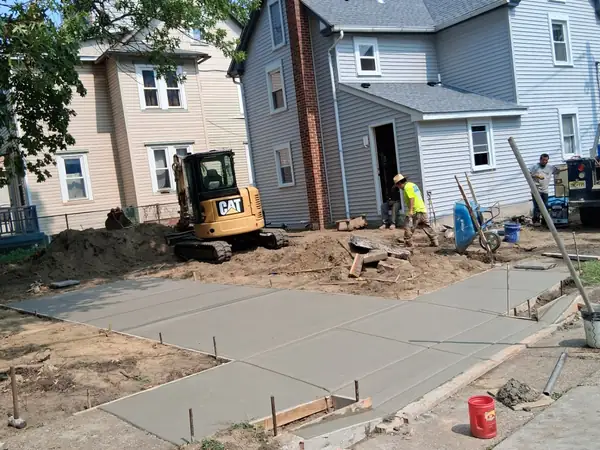
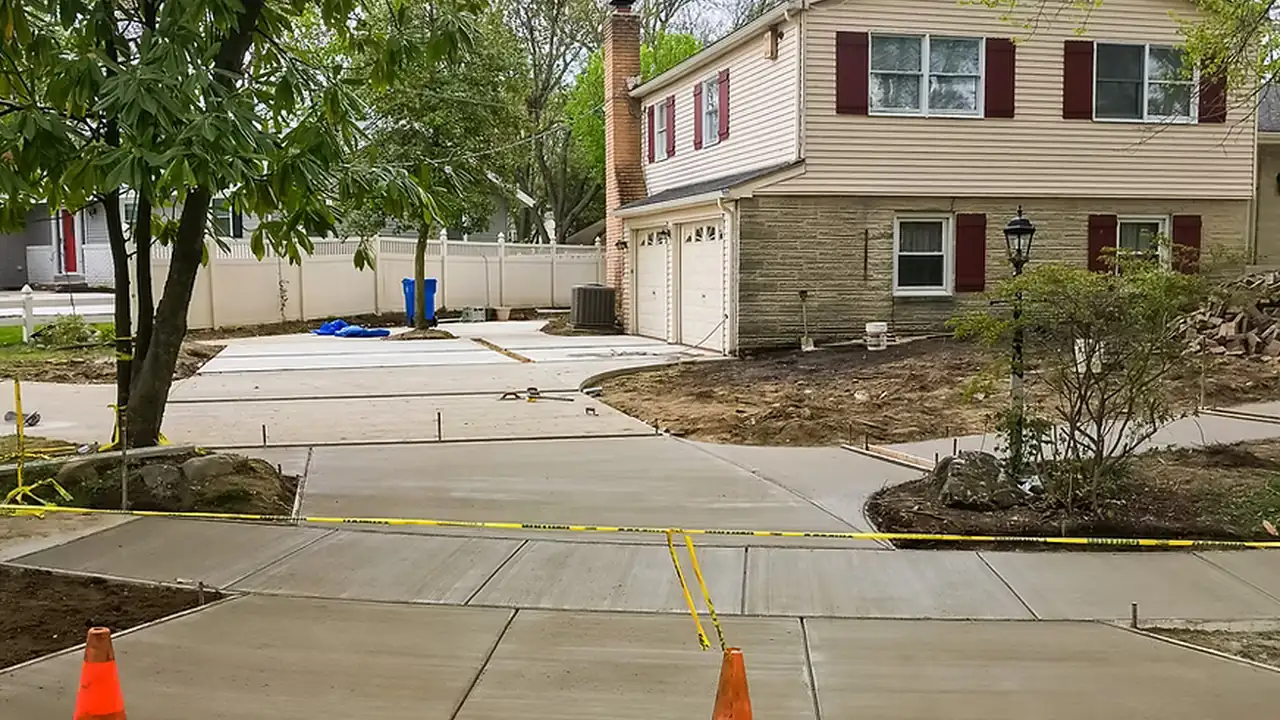
Sidewalk, curb, and apron repair covers removing and replacing damaged sections of the concrete walk, street curb, and driveway apron that sit in or adjoin the municipal right-of-way, work that is typically inspected by the township because it affects public property along the street frontage.
When you need it — and when you don't.
When you need this
- A sidewalk panel has heaved, sunk, or cracked enough to create a trip hazard, often from a tree root beneath it, and the township or a neighbor has flagged it as a liability concern.
- The curb along your frontage has spalled, cracked, or crumbled from years of snowplow contact and deicing salt exposure, leaving an uneven or unsafe edge at the street.
- The driveway apron, where the driveway crosses the right-of-way to meet the street, has settled or heaved separately from the rest of the driveway, creating a lip, dip, or drainage issue at that transition.
- You are required to bring your frontage into compliance as a condition of a permit for other work, such as a new driveway apron cut or a curb cut for a new driveway.
- A curb ramp at a corner or crosswalk near your property is missing or does not have a detectable warning surface, which is typically flagged during township road or sidewalk programs.
When this is the wrong fix
- If a sidewalk panel has only a shallow, narrow crack or minor surface wear without a trip hazard (generally a lip under some threshold the township uses to judge hazard versus cosmetic wear), grinding the lip down or a small patch may be all that is required rather than full panel replacement.
- If the issue is isolated to one panel and the panels on either side are sound, replacing just that panel is usually correct; there is rarely a reason to replace an entire run of sidewalk because of one bad section.
- If a curb or sidewalk issue is actually being caused by an active tree root that has not been addressed, replacing the concrete without dealing with the root (removal or a root barrier) generally means the same heave returns within a few years.
How it's done.
Because sidewalks, curbs, and aprons sit in the municipal right-of-way, this work generally starts with confirming what the township requires for permitting, inspection, and any specific standards for the ramp, apron, or curb profile before demolition begins. Damaged panels or curb sections are sawcut at the nearest joint to isolate clean, sound edges rather than breaking concrete at a random point, then removed and hauled off. The subgrade is inspected and compacted, with any root intrusion addressed and a compacted aggregate base placed to the appropriate depth. Forms are set to match the required profile: sidewalk panels are typically formed at a consistent thickness and cross-slope, curb is formed to the township's standard curb face and reveal height, and driveway aprons are formed with the thicker section and reinforcement appropriate for the vehicle loads and right-of-way crossing. Where the work includes a corner curb ramp, a detectable warning surface (the truncated-dome panel required at pedestrian ramps under ADA-style accessibility standards) is set into the ramp. Concrete is placed, finished, and jointed to match the adjoining sections, and the work is left for township inspection before or after backfill and restoration, depending on local procedure.
Materials & standards
| Item | Typical practice |
|---|---|
| Sidewalk slab thickness | Typically 4 inches for standard pedestrian sidewalk; often thicker where a driveway apron crosses the sidewalk because it carries vehicle loads |
| Apron thickness and reinforcement | Aprons are generally poured thicker than a standard sidewalk panel and reinforced, since they carry vehicle loads at the point where settlement is most common |
| Base thickness | Compacted dense-graded aggregate base beneath sidewalk, curb, and apron sections, generally in the 4-inch range, adjusted for soil conditions |
| Curb profile and reveal | Curb face height, reveal (exposed height above pavement), and back-of-curb dimensions generally follow the township's standard detail. |
| Detectable warning surface | A truncated-dome panel set into curb ramps at corners and crosswalks, sized and placed per ADA-style accessibility guidance for pedestrian ramps |
| Joint matching | New panels are jointed and, where possible, matched in width and score pattern to the adjoining existing sidewalk or curb run |
| Permitting and inspection | Work in the right-of-way is generally permitted and inspected by the township. |
How the job runs.
- 01
Identify the damaged panels, curb sections, or apron area, and confirm township permit and inspection requirements for right-of-way work before starting.
- 02
Sawcut at the nearest sound joint to isolate the section being removed, then break out and haul away the damaged concrete.
- 03
Inspect and prepare the subgrade, removing or addressing tree roots and any unstable material found beneath the old concrete.
- 04
Place and compact the aggregate base to the depth appropriate for a sidewalk panel, curb section, or apron.
- 05
Set forms to match the required profile (panel thickness and cross-slope, curb face, or apron thickness), including a detectable warning panel where a curb ramp is involved.
- 06
Place, finish, and joint the concrete to align with the adjoining existing sections.
- 07
Cure the new concrete and coordinate final township inspection before the area is considered complete.
What moves the number.
Every site is priced individually after we have walked it, in writing, with the scope itemized. These are the variables that decide where a job lands.
| Factor | Effect on price |
|---|---|
| Number and location of panels or curb sections | A single isolated sidewalk panel is a much smaller job than a continuous run of curb or several disconnected panels across a frontage. |
| Tree root removal | Where a root is the cause of the heave, root removal or a root barrier adds work beyond the concrete replacement itself and affects how long the repair lasts. |
| Right-of-way permitting and inspection | Township permit requirements, required inspections, and any restoration standards for the right-of-way add administrative steps and scheduling constraints that a private slab does not have. |
| Curb ramp and detectable warning requirements | Adding or upgrading a corner curb ramp with a compliant detectable warning surface is a more involved scope than a straight run of curb replacement. |
| Matching existing conditions | Matching an existing sidewalk's joint spacing, curb profile, or apron width to abutting sections that were not part of the original job takes extra care and layout. |
| Traffic control and site access | Work near an active street or busy sidewalk may require traffic control measures and affects how efficiently the crew can stage materials and equipment. |
Questions we get, answered.
In most South Jersey municipalities, the property owner is responsible for maintaining the sidewalk and curb along their frontage even though it sits within the public right-of-way, and the township inspects the work once it is done.
Generally yes, because the sidewalk, curb, and apron sit in the municipal right-of-way rather than on private property, and the township typically requires a permit and inspects the finished work.
If a tree root caused the original heave and the root was not removed or blocked, it typically continues growing under the new concrete and will heave the panel again over time. Addressing the root, or installing a root barrier, is usually necessary for the repair to hold.
It is the panel of raised, truncated domes set into a curb ramp at a corner or crosswalk, intended to give pedestrians who are blind or have low vision a tactile cue that they are entering the street. It is generally required as part of ADA-style accessibility standards whenever a curb ramp is built or replaced, including as part of sidewalk repair projects that touch a ramp.
The apron crosses the right-of-way and typically needs to be built thicker and reinforced because it carries vehicle loads right at the transition to the street, an area also subject to plow and salt exposure. Settlement there is common and often needs to be treated as a right-of-way repair permitted and inspected separately from work on the rest of the private driveway.
Yes, in most cases a single damaged panel can be sawcut out and replaced on its own as long as the adjoining panels are sound, with the new panel jointed to match the existing sidewalk. There is generally no need to replace an entire run just because one section has failed.
Yes. We replace broken and lifted sidewalk sections, curbs and driveway aprons across Cherry Hill, Marlton, Collingswood, Haddonfield, Voorhees and the rest of South Jersey, and we handle the township permit and inspection.
Call us at (856) 488-2227 or request a free estimate. We look at the flagged sections, confirm what the township requires, replace the panels and schedule the inspection.
Where we do this work.
- Cherry Hill, NJ
- Collingswood, NJ
- Haddonfield, NJ
- Marlton, NJ
- Medford, NJ
- Moorestown, NJ
- Mount Laurel, NJ
- Mullica Hill, NJ
- Voorhees, NJ
- Washington Township / Sewell, NJ
- Berlin, NJ
- Camden, NJ
- Gloucester Township, NJ
- Haddon Township, NJ
- Maple Shade, NJ
- Pennsauken, NJ
- Sicklerville, NJ
- Merchantville, NJ
- All Service Areas ↗