
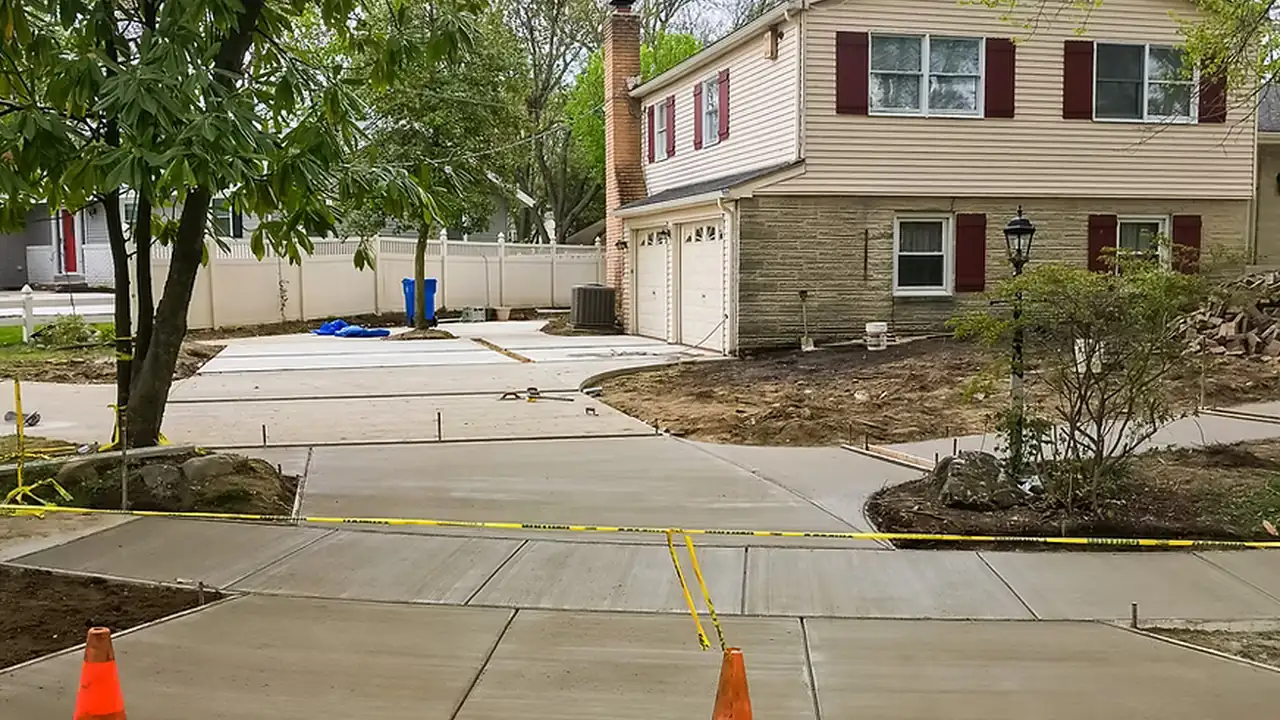
Concrete Driveway Replacement
Family-owned since 1979Licensed & insuredFree written estimates
Family-owned in Cherry Hill since 1979
“Easy, clean, professional experience from start to finish. Highly recommend!”
Erik R., Google review “Very friendly and professional.”
Terri H., Google review
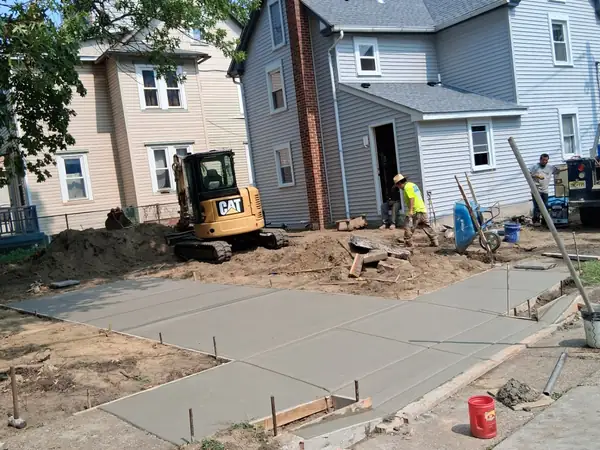
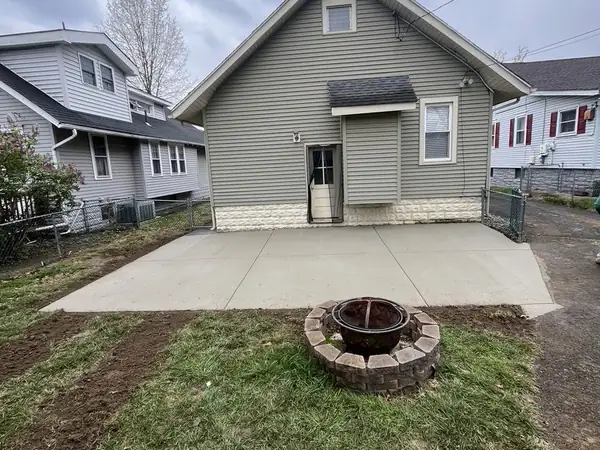
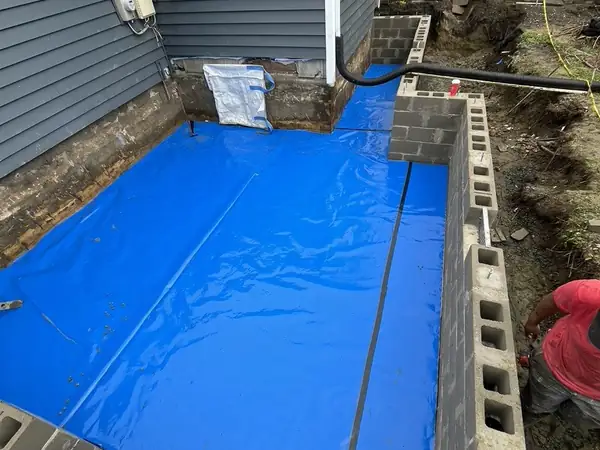
Concrete driveway replacement means removing an existing slab down to subgrade, correcting the base and drainage that let it fail, and pouring a new reinforced slab at proper thickness and pitch, rather than patching or resurfacing a driveway whose problems start below the surface.
When you need it — and when you don't.
When you need this
- Large slabs of the driveway are cracked into multiple pieces, with sections that rock or have dropped relative to each other, rather than a single hairline crack.
- Winter salt use over the years has scaled and pitted the surface down to exposed aggregate across most of the slab, not just a small patch near the garage.
- The apron at the street has settled or heaved so there is a lip or dip where the driveway meets the road, which usually points to fill or base failure rather than a surface problem.
- Water ponds on the driveway or sheets toward the house foundation instead of away from it, which a resurfacing overlay will not correct because it follows the existing pitch.
- A tree root under one edge has lifted a section an inch or more, creating a trip hazard that keeps recurring even after grinding the ledge down.
When this is the wrong fix
- If the slab is structurally sound with only fine hairline cracks or minor surface scaling in one spot, a concrete resurfacer, an overlay, or localized slab repair is usually the more honest and less expensive answer than full replacement.
- If the concrete itself is fine but has settled evenly as a unit due to a void underneath, slab lifting (mudjacking or polyurethane foam injection) can restore grade without breaking out the slab at all.
- If there is planned utility, sewer, or water service work that runs under or near the driveway footprint, that work should be completed first; pouring new concrete before it is finished means cutting into a new slab later.
- If the driveway simply needs a different surface character, such as a lower cost or a different look, asphalt or a paver driveway may be a better fit for the site than concrete replacement.
How it's done.
Replacement starts by sawcutting and breaking out the existing slab, then excavating to subgrade and hauling the debris and spoil off site. Native soil in much of South Jersey is sandy or has poorly draining pockets of clay, so the subgrade gets proof-rolled and any soft or organic material is undercut and replaced. A layer of dense-graded aggregate (DGA, sometimes called quarry process or QP) is placed and compacted in lifts with a plate or roller compactor to serve as a stable, free-draining base under the slab, correcting the single biggest reason older driveways here fail: many 1960s-70s slabs were poured thin, directly onto native soil with no stone base at all. Forms are set to the corrected grade and pitch, reinforcement is placed, and an air-entrained concrete mix suited to freeze-thaw exposure is placed, screeded, floated, and finished. Control joints are cut or tooled at intervals sized to the slab thickness, and isolation joint material is set against the garage slab, foundation, and any adjoining walk or apron so those elements can move independently.
Materials & standards
| Item | Typical practice |
|---|---|
| Slab thickness (driveway) | Typically 5-6 inches for standard passenger vehicle use; thicker sections are common at the apron and at any area subject to heavier loads |
| Base thickness | Compacted dense-graded aggregate (DGA/quarry process), typically 4-6 inches, compacted in lifts over undisturbed or engineered subgrade |
| Reinforcement | Welded wire mesh or rebar on chairs for driveways; synthetic fiber mesh is common for shrinkage/temperature control but is not a substitute for structural reinforcement in vehicle-load slabs |
| Air-entrained mix strength | General practice for exterior flatwork in a freeze-thaw climate is a higher-strength, air-entrained mix designed for exposure to deicing salts. |
| Control joint spacing | General rule of thumb is roughly 2 to 3 times the slab thickness in feet, cut within the first day of placement to control where shrinkage cracking occurs |
| Pitch | Positive slope away from the house and garage, generally on the order of 1/8 to 1/4 inch per foot, to move surface water toward the street or a drainage path |
| Isolation/expansion joints | Placed wherever the new slab meets the garage floor, foundation, steps, or an existing curb/sidewalk so the elements are not rigidly tied together |
How the job runs.
- 01
Evaluate the existing slab, base condition, drainage pattern, and apron tie-in, and mark utilities before any excavation begins.
- 02
Sawcut and demolish the existing concrete and remove debris and any unsuitable subgrade material from the site.
- 03
Grade and compact the subgrade, undercutting and replacing soft spots, then place and compact the dense-graded aggregate base.
- 04
Set forms to the corrected pitch and layout, place reinforcement, and install isolation joint material at the garage, foundation, and adjacent hardscape.
- 05
Place the air-entrained concrete, screed and float it to grade, and finish the surface (broom, exposed aggregate, or stamped as selected).
- 06
Cut control joints and allow the slab to cure under proper conditions before opening it to foot or vehicle traffic.
- 07
Apply a curing compound or sealer only after adequate cure time, and advise on avoiding deicing salt through the first winter.
What moves the number.
Every site is priced individually after we have walked it, in writing, with the scope itemized. These are the variables that decide where a job lands.
| Factor | Effect on price |
|---|---|
| Total square footage and slab thickness | More area and a thicker driveway-rated section require more excavation, base stone, reinforcement, and concrete, which scales the job up directly. |
| Subgrade condition | Soft, wet, or organic soil found under an old slab often needs to be undercut and replaced with stone, adding excavation and material beyond what a straightforward tear-out would need. |
| Access for equipment and disposal | A driveway that a mini excavator and concrete truck can reach directly moves faster than one requiring hand demolition, wheelbarrow placement, or a pump truck. |
| Finish selection | A broom finish is the most straightforward; exposed aggregate and stamped/colored finishes involve extra labor, materials, and sequencing that add cost. |
| Apron and right-of-way work | If the apron section within the municipal right-of-way is being replaced along with the private driveway, that portion may fall under separate township requirements and inspection. |
| Site restoration | Regrading, seeding, or replacing adjacent landscaping, edging, or a section of walk disturbed during demolition adds to the scope beyond the slab itself. |
Questions we get, answered.
Many driveways from that era were poured thin and directly on native soil with no compacted stone base underneath, so the slab had nothing stable and free-draining to sit on. Decades of freeze-thaw cycling, tree root growth, and road salt exposure then accelerated cracking and surface scaling that a proper base and modern air-entrained mix are designed to resist.
For a vehicle-load driveway slab, welded wire mesh or rebar placed on chairs to hold it near mid-depth is standard practice for structural reinforcement. Synthetic fiber mesh helps control plastic shrinkage cracking during curing but is not a structural substitute; many driveway pours use both fiber in the mix and wire or rebar for reinforcement.
Concrete gains strength over time, and general practice is to keep vehicle traffic off it well beyond the point it looks hard, with a longer wait before its first exposure to deicing salt. Salting or sealing too early, before the slab has cured and dried sufficiently, is a common cause of surface scaling in the first winter.
Resurfacing applies a thin overlay over an existing slab and only makes sense when that slab is structurally sound with cosmetic wear; it will not fix a cracked, settled, or poorly pitched driveway because it follows whatever is underneath it. Replacement removes the slab and rebuilds the base and drainage, which is the correct approach when the problem originates below the surface.
Driveway replacement work, especially the apron section within the street right-of-way, is typically subject to township permitting and inspection separate from the private portion of the driveway.
Yes, when the private driveway slab is otherwise sound and only the apron at the street has settled, heaved, or cracked, that section can often be replaced on its own. Because the apron sits in the municipal right-of-way, that portion of the work is generally inspected by the township separately from the rest of the driveway.
Yes. We replace and pour concrete driveways across Cherry Hill and South Jersey from our yard on Park Rd, with our own crew doing the tear-out, base, forming, pour and finish.
Both. We pour new driveways for new homes and additions as well as full replacements of old driveways, aprons and the walk sections that tie into them.
Where we do this work.
- Cherry Hill, NJ
- Collingswood, NJ
- Haddonfield, NJ
- Marlton, NJ
- Medford, NJ
- Moorestown, NJ
- Mount Laurel, NJ
- Mullica Hill, NJ
- Voorhees, NJ
- Washington Township / Sewell, NJ
- Berlin, NJ
- Camden, NJ
- Gloucester Township, NJ
- Haddon Township, NJ
- Maple Shade, NJ
- Pennsauken, NJ
- Sicklerville, NJ
- Merchantville, NJ
- All Service Areas ↗