Drainage & French Drains in Camden, NJ
City of Camden, Camden County. Family-owned, licensed and insured, and self-performing every stage of the work since 1979.
We handle yard drainage and foundation water for homes and properties in the City of Camden. Camden has a combined sewer system, where storm water and wastewater share the same pipes, which makes keeping rain on the right path especially important. We fix downspouts, grading and French drains, confirm what the city allows, and restore what we open.
Free written estimates. Licensed and insured. Every site is quoted individually.
Free estimate in Camden, NJ
Drainage in a combined-sewer city
Camden's sewer system is combined: storm water and household wastewater travel in the same pipes, operated by American Water under contract with the city and treated by the Camden County MUA. In heavy rain, those pipes carry far more than on a dry day.
For a homeowner, that has two practical consequences. First, what gets connected to the sewer matters, so we confirm with the city where yard and roof water may legally go before tying anything in. Second, a basement backup during a big storm may come from the public side rather than your own property. Knowing the difference saves money.
Is it drainage or a backup?
Clear water seeping through a basement wall or pooling in the yard after rain is a drainage problem we can fix on your property. Sewage coming up through a floor drain during a storm may be the combined system surcharging. If neighbors are seeing the same thing at the same time, call the city's sewer operator. If it's only your house, the problem is more likely your own line.
Sewage backing up right now? Call (856) 488-2227 — 24/7 emergency service.
Emergency sewer repair in Camden ↗Start with the roof
On most homes the largest single source of water at the foundation is the roof. Downspouts that empty against the wall, or into buried leaders that have broken, deliver all of it into the soil beside the basement. Re-routing roof water in solid pipe to a legal outlet is usually the first fix we recommend.
What we look for
We walk the property, ideally after rain, and trace water from where it starts to where it stops:
- Downspouts discharging at the foundation or into broken leaders
- Walks, patios or yards pitched toward the house
- Water arriving from a neighboring lot or the street
- Low spots where soil has settled beside the foundation
- Areas where pavement leaves rain no place to soak in
French drains where water moves underground
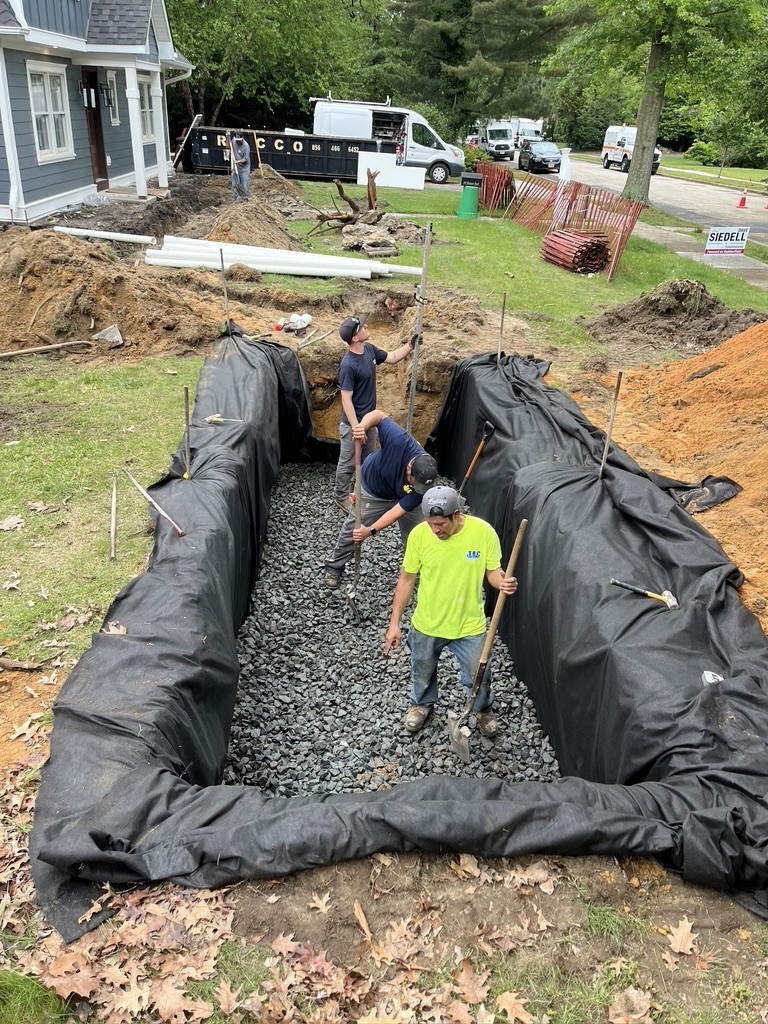
When water travels below the surface toward a foundation, a French drain intercepts it: a trench lined with filter fabric, filled with clean stone, carrying perforated pipe at a continuous fall to an outlet. The fabric keeps soil out of the stone; the continuous fall keeps the pipe from holding water. We set grade with a laser on every run.
Catch basins for paved yards
Many city properties have yards that are mostly paved. Rain can't soak in, so it runs to the lowest point — often a back door or basement stairwell. A catch basin at that low point, piped to an outlet, collects the water before it reaches the house.
Regrading against the foundation
Soil settles beside foundations over time until the ground pitches toward the house. Regrading so it falls away for the first few feet keeps surface water off the wall. Fill is compacted in lifts so the new grade holds.
Concrete that sheds water
Settled walks and patios that tip toward the house turn every storm into foundation water. We can cut out and replace the failed section with the pitch corrected, and we self-perform the concrete so restoration is matched and properly finished.
A legal outlet for every system
Every drainage system needs somewhere legitimate to discharge. On city lots that may be the street, a dry well where soil and space allow, or another outlet the city permits. We confirm before building, and we never direct water onto a neighboring property.
Utilities and permits
Water in Camden comes from the city system run by American Water, New Jersey American Water or the Merchantville-Pennsauken Water Commission depending on the neighborhood. We have all utilities marked and locate private lines before digging. Work that opens city pavement requires permits and inspection, which we handle.
Older city properties
Many Camden homes are older rowhouses and twins on small lots, where every foot of yard counts. Drainage on these properties has to be compact and precise: shallow lines, short runs to the outlet, and hand-digging along foundations and party walls where equipment can't fit. We plan the route before we dig so the finished work takes as little space as possible, and we restore paving and concrete so the yard is usable again the day we leave. Cleanouts are added where lines turn, so the pipe can be flushed if leaves or grit ever build up.
What a finished job looks like
When we're done, trenches are backfilled and compacted, grades fall away from the house, downspout lines end at a proper outlet, and any concrete we cut is restored. The test is the next heavy storm: water should leave the foundation area instead of collecting against it.
Camden questions, answered.
Storm water and wastewater share the same city pipes. We confirm with the city where your roof and yard water may legally go before connecting anything.
Not necessarily. In a combined system, the public side can surcharge in big storms. If neighbors have the same problem, call the city's sewer operator first.
Yes. A catch basin at the low point, piped to an outlet, collects water before it reaches the house.
Yes. If work opens city pavement, we file for the permit and schedule the inspection.
Drainage & French Drains — Camden, NJ